
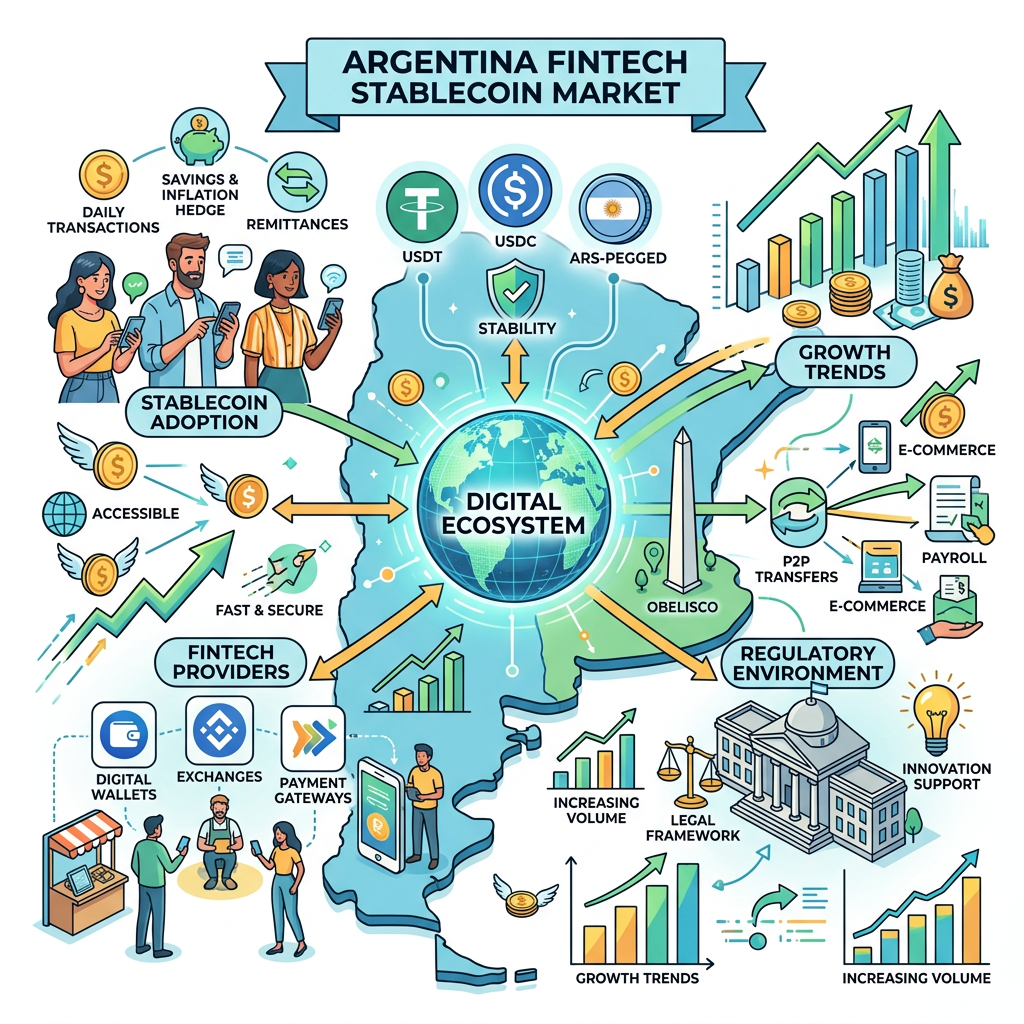

Since the 1970s, Argentines have lived through repeated cycles of hyperinflation, currency collapses, sovereign defaults, and government-imposed capital controls. Most recently, a dual exchange rate system created two parallel economies operating simultaneously: one at the official peso rate and one at the informal “blue dollar” rate, a black market exchange rate which frequently diverged from the official rate by more than 50%. Annual inflation reached 292.2% in 2024. By 2025, President Milei decided to target inflation with a series of fiscal shock therapy that eliminated a national budget deficit running at approximately 5% of GDP and brought inflation down to 31.3% . While the inflation rate has come down significantly, the recent rebound in inflation from 31% to 33.5% reflects the lingering structural problems in the economy. The Argentine population could not trust its own currency nor access its own banking system efficiently. In 2025, Argentina recorded $93.9 billion in total crypto transaction volume and ranked second in Latin America — a clear sign the population had turned to alternatives enabled by technology. With 20% of the population now using crypto, of which 62% use stablecoins (40% above global average) as the de facto trusted currency, this rapid adoption of digital currencies drove the rise of consumer platforms such as Mercado Pago, Ualá, Ripio, Lemon Cash, and Bitso. Each of these platforms give millions of Argentines their first access to digital payments, credit, and dollar-equivalent savings. While the consumer layer is now complete, an infrastructure layer which connects these platforms and enables easy usage by users presents an unique investment opportunity.
To understand where the opportunity is, one first needs to understand what the incumbents have built and precisely where each one stops. These category leaders create a specific problem. Each builds walls around its own users rather than bridges between them, and the merchants caught in the middle pay the price.
Mercado Pago (Merpago) is a popular payment processor developed by MercadoLibre, the “Amazon of Latin America”. By 2025, Merpago had reached 78 million monthly active users across Latin America and grown its credit portfolio by 90% YoY. Its credit card portfolio increased 114% YoY while loan portfolio grew 100% YoY in Q3 2025. In August 2025, Merpago launched its credit card in Argentina to target the structural market opportunity where over 60% of Argentine adults lack a credit card. But that dominance is also its structural problem. Every one of those 11.3 billion transactions is siloed inside Mercado Pago’s own dashboard and is invisible to the Ripio wallet or Lemon Cash Visa card that the same merchant’s customers used on the same day. Merpago explicitly filed an antitrust action against 36 Argentine banks to protect its own payment network. The investor opportunity here is not to compete with Mercado Pago but to build the layer that sits beneath it and connects it to the rest of the ecosystem it refuses to integrate with itself.
Alongside Merpago, the neobank Ualá was built specifically for citizens without any prior banking relationship. Ualá pursued a licensing strategy by acquiring Argentina’s Wilobank to secure full banking licenses and giving it a regulatory foundation. The company achieved profitability in Argentina in 2024 and secured an additional $195 million in March 2026 which brings its valuation to $3.2 billion. It now serves over 8 million users and serves 20.6% of the Argentine population. This scale confirms that Ualá has already won a large segment of Argentine users who hold their money digitally. However, Ualá’s have many issues. Its balance cannot settle a USDT transaction on Ripio, cannot reconcile automatically with a Merpago QR payment, and has no API connection to any of the crypto platforms its own users also rely on. The wallet is full. The pipes out of it are broken. For an investor, this means Ualá’s 8 million users represent 8 million merchants and consumers who need an interoperability layer that Ualá has no commercial reason to build for them.
On the exchange side, Bitso dominates stablecoin conversion where USDT and USDC together represented 72% of all crypto purchases (50% and 22% respectively). Even as inflation fell, crypto adoption accelerated rather than retreated. Average monthly users in 2025 were four times higher than during the 2021 bull market peak. Across Latin America as a whole, total crypto transaction volume reached 10% of global crypto activity. Ripio in 2025 launched wARS, a peso-pegged stablecoin that enables 24/7 cross-border settlement between Argentina and Brazil. Lemon Cash issues Visa cards allowing users to hold and spend USDT or USDC at any point-of-sale terminal with real-time conversion. Each of these platforms is impressive in isolation. Ripio’s wARS solves cross-border settlement, but only for Ripio users. Lemon Cash’s Visa card solves stablecoin spending, but only for Lemon Cash users. Bitso dominates stablecoin conversion, but completely siloed from Mercado Pago and Ualá.
None of them has any commercial incentive to make it easy for a merchant to use a competitor’s rails alongside their own. This means none of them will ever build the connective layer the market needs. For an investor, each of these companies is not a target to compete with but a future customer of the infrastructure company that connects them.
The user side of this market is mature, competitive, and well-capitalized. So where is the investment opportunity? It is in the infrastructure layer and it is open precisely because these incumbents are too invested in protecting their own networks to build it.
The result of five competing platforms each protecting its own network is a merchant experience that is genuinely broken. Today, a peso held in Ualá cannot seamlessly settle a USDT transaction on Ripio without manual conversion steps. A merchant receiving payment through Mercado Pago QR cannot automatically reconcile a simultaneous USDT inflow from Lemon Cash in the same dashboard. An Argentine business exporting to Brazil cannot route through Ripio’s wARS corridor and Ualá’s balance in a single API call. Every merchant operating across these platforms is converting between peso and stablecoin entries by hand, looking up exchange rates at the moment of each transaction, and producing financial statements that no accounting software supports because QuickBooks does not handle Transferencias 3.0 or USDT inflows.
This is structurally identical to the US payments market in the mid-2000s. It is worth understanding in detail because the mechanism is identical to what Argentina is experiencing today. PayPal had 70 millions of users for online payments in 2005 but was designed as a consumer wallet, not a developer tool. Integrating it required navigating clunky APIs, a painful merchant approval process, and settlement timelines measured in days. Visa and Mastercard dominated card transactions but operated through a web of acquiring banks, each with its own contract, its own fee structure, and its own integration requirements. A developer building an e-commerce site in 2005 who wanted to accept PayPal, Visa, and Mastercard simultaneously had to maintain three completely separate integrations, reconcile three separate settlement reports, and manage three separate dispute processes.
Dozens of payment gateway companies tried to solve this by acting as intermediaries like Authorize.net, PayFlow, Verisign. However, they just added another layer of complexity because they were built to connect merchants to individual networks rather than to abstract all networks simultaneously. The market stayed broken for a decade. Stripe changed this in 2010 by building a developer-first API treating all payment networks as interchangeable inputs. A merchant just needs to integrate Stripe once and get access to all of them simultaneously. Stripe did not beat those incumbents by having better users. It beat them by being the layer none of them would build for each other. Stripe’s insight was that the value was not in owning the user relationship but in owning the connection between the platforms that already did. Argentina’s payments market is at exactly that inflection point today. The more Argentina’s consumer platforms grow, the more acute this fragmentation becomes. Merchants must operate across both peso rails and stablecoin rails simultaneously, and no product anywhere handles both.
The US fragmentation in 2005 involved multiple fiat payment networks that at least shared a common currency. Argentina’s fragmentation in 2026 involves multiple fiat payment networks and multiple stablecoin rails operating in different currencies simultaneously. A merchant in Buenos Aires today faces the same reconciliation nightmare that a US developer faced in 2005 plus the added complexity of managing peso-denominated and dollar-denominated transactions that cannot be natively compared in any single system. The company that solves this is not just the Stripe of Argentina, it is Stripe with a crypto layer that Stripe itself has never had to build because the US market never required it.
This presents the vertical worth investing right now: the B2B SaaS infrastructure that connects each of these incumbents and makes it easier for merchants to operate across all of them simultaneously.
A specific area in the B2B SaaS infrastructure vertical is unified fiat payment reconciliation where a single API ingests all peso-denominated payment methods between Mercado Pago QR, Transferencias 3.0, domestic cards, Ualá and produces one dashboard with one reconciled P&L. An Argentine merchant who signs up for this product goes from managing three separate systems to managing one. That reduction in operational friction alone is the value proposition, and it does not require stablecoins to work.
The infrastructure vertical opportunity described above is not hypothetical, the market has already begun to form around it. Rebill is an example of a company building on this vertical opportunity. It is an early-stage company with 19 people that is building toward this infrastructure layer. It abstracts Mercado Pago, Transferencias 3.0, cards, and over 100 local payment methods into a single API with unified reconciliation and settlement for LATAM merchants which incorporated the traditional fiat side. The next funding round is the moment to back its extension into stablecoin rail integration such as connecting USDT and USDC inflows from Ripio and Lemon Cash into the same merchant dashboard as peso payments and giving it the complete connective layer between all three platforms.
Even if Rebill is fully complete, there is still more to be done. Once that unified peso-plus-stablecoin layer is live, the subsequent extensions are organic rather than separate bets. Cross-border B2B settlement for the Argentina-Brazil trade corridor will become a routing feature that comes up next. It can solve the problem for 95% of Argentine SMEs who are not crypto-native and save the 3–5% in correspondent banking fees on every cross-border invoice. It is the companies in this infrastructure vertical that will become the foundational financial rails of Argentina’s digital economy and the most natural acquisition targets for the global payment networks that currently lack them.
The exit precedent is already set. Visa acquired Brazilian core banking platform Pismo for $1 billion in 2023 not for its users, but for its ability to bridge traditional banking infrastructure and modern digital payment rails which is a capability Visa needed and would never build internally because doing so would help competitors run on its own network. Rebill is building that same category of bridge in Argentina. Mastercard is pursuing the equivalent through its regional stablecoin partnerships. Neither has it natively in Argentina yet. The investor who backed Stripe in 2010 was not betting on any single merchant but betting that every merchant would eventually need payments infrastructure. In Argentina, that bet is still open.
Citations:
Banco Central de la República Argentina. Informe sobre el Mercado de Cambios. BCRA, Q4 2023.
Atlas21 / BCRA. “Argentina: Stablecoin Adoption is Growing.” October 2024; BCRA inflation data through August 2024.
BBVA Research. “Argentina: The 2025 Inflation Was the Lowest in 8 Years.” January 2026.
Retail Banker International. “Mercado Pago Seeks Banking Licence in Argentina.” May 2025.
MercadoLibre Inc. Q4 2025 Financial Results. February 2026.
MercadoLibre Inc. Q4 2025 Financial Results. February 2026.
MercadoLibre Inc. Q3 2025 Earnings Transcript. Motley Fool / MercadoLibre Investor Relations, October 2025.
MercadoLibre Inc. Q3 2025 Financial Results. October 2025.
MercadoLibre Inc. Q4 2025 Financial Results. February 2026.
Retail Banker International. “Mercado Pago Seeks Banking Licence in Argentina.” May 2025.
Neobanque. “Ualá Pursues Banking Licenses Across Latin America for Regional Expansion.” February 2025.
Neobanque. “Ualá Pursues Banking Licenses Across Latin America for Regional Expansion.” February 2025.
Chainalysis. 2025 Latin America Crypto Adoption Report. October 2025.
Bitwage. “State of Stablecoins in Argentina, September 2025.” September 2025.
Bitwage. “State of Stablecoins in Argentin, September 2025.” September 2025.
CoinDesk. “Latin America’s Crypto User Growth Outpaced U.S. by 3x in 2025.” March 2026.
CoinDesk. “Latin American Crypto Company Ripio Launches US Dollar-Pegged Stablecoin.” August 2023.
Bitget News. “Latin America’s Rapid Adoption of Stablecoins Establishes a New Benchmark.” November 2025.
CoinDesk. “Tether and Circle Stablecoin Purchases Dominate in Argentina.” February 2024.
Bitwage. “State of Stablecoins in Argentina, September 2025.” September 2025.
Blockhead. “When Fiat Fails, Crypto Fills the Gap, Argentina Proves It.” December 2025.


Leave a Reply